
Stranger Things is a Sci-Fi/Horror TV series that was first aired on July 15th, 2016 on popular streaming service Netflix. It was a huge success and has since had another series produced and more in the process of being produced. It has become somewhat of a phenomenon, not only because of how well-made and entertaining it is, but also because of how it is essentially an amalgamation of several other products from the 70s and 80s but yet still manages to be original and fresh for the audience. Throughout this essay I am going to analyse how intertextuality has been used in Stranger Things and the things that led it to become so popular as well as how the intertextuality used changes how the audience views the characters and the overall narrative.
Put simply: intertextuality is when a text references another text to help shape its own narrative. It is commonly used in postmodern texts and has several purposes, mostly to construct some sort of emotional response from the audience such as nostalgia but can also be an indicator as to whether a text is in canon to another. For example, in the James Bond series when an agent will reference a previous one or an element from a previous film. Intertextuality can be shown in a few ways such as the composition of the shots, the dialogue of the characters or even through props and the mise-en-scene.
I will also being analysing how the Stranger Things fandom and fandoms in general help to shape the way a product is produced and also how fandom is an important part of modern-day mass media, as well as how fandom can also have negative effects on the views of products by other people.
First and foremost, the reason that intertextuality is such a prominent feature in media products now is in part due to what’s known as the 30-year cycle or the nostalgia pendulum theory. The theory goes that “it takes about 30 years for a critical mass of people who were consumers of culture when they were young to become the creators of culture in their adulthood.” (Metzger, 2017) This then results in modern products being heavily influenced by products that released around 30 years prior.
In the research done by Patrick Metzger he studied 500 film remakes and found that the 30-year cycle was backed up by his findings, showing a large amount of remade films come out around 30 years after the original.
| Metzger, 2017 |
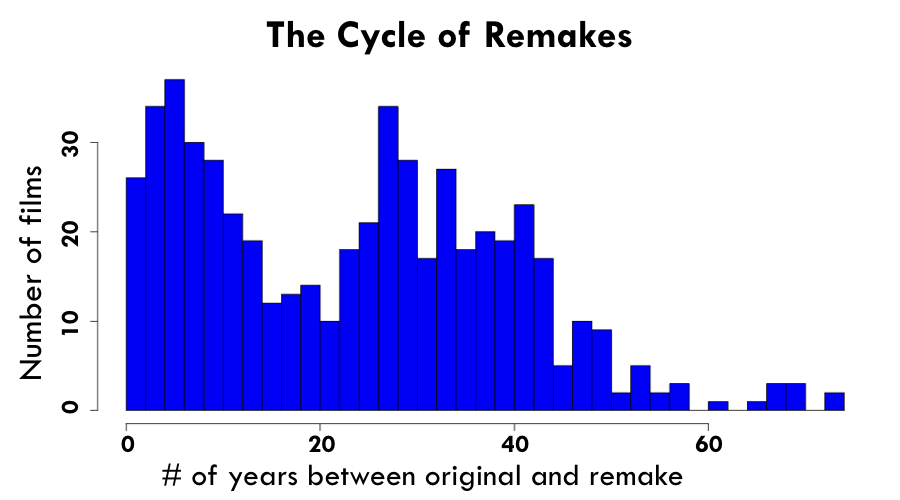
This 30-year cycle is also in part responsible for why intertextuality has become so common in post-modern media products. If the way films are being made now is by making them based on or with inspiration taken from products that released 30 years ago, there’s bound to be plenty of references to them and that couldn’t be truer for the products that have inspired Stranger Things.
The reason that intertextuality is so effective is because like I mentioned earlier, is because it invokes an emotional response from the audience which in turn makes us enjoy it more. The emotional response can be any emotion though, whether that be sad or happy or angry. It can also be used to help tell the story, by using references to help the audience gauge how they should feel about the story.
An example of intertextuality used to make the audience feel happy is in the movie Deadpool when the protagonist makes a joke about how he got his own film because he blew up someone who’s name rhymes with “Pullverine”. This was an obvious shot at the super hero Wolverine, and fans of the super hero canon will have picked up on this instantly and found it funny, thus making them enjoy the movie more.
However, it is said that intertextuality and references to things from the past is actually just people trying to remember how good things used to be and almost as a metaphor for how corrupt and depressing the modern world is. In a quote by Barlett, Myke he said in regard to intertextual references in Stranger Things: “Stranger Things is a prime example of how we use nostalgia to make meaning of the present or to simply attempt to escape its horrors.”(Barlett, Myke, 2017) While quite morbid, it is true, people love nostalgia and this could be another contributing factor to the abundance of intertextuality and the strength of the 30-year cycle theory.

Professor Harold Bloom who wrote a book called “The Anxiety of Influence”, argued that all poetry is made in reaction to what came before it. This can also be adapted to refer to all art forms including film and television. The anxiety is that authors and creators want to make something that has taken inspiration from what they are familiar with but yet still make it original. In order to do this Bloom said that the author must go through the process of “Poetic Misreading or Misprision Proper” which is essentially deliberately misreading their inspiration in order to create something new and original. This is exactly what Stranger Things has done with its plot and its characters, and so while it is very similar to the films it uses as inspiration, it is still totally original and entertaining which is why it was so successful. It took all the archetypes we are used to and presented them in a way that was new, and so the audience loved the familiarity and the fresh take on it too.
Bloom also says that there are 6 ways in which authors can create something original and escape their influences. These ways are:
Clinamen, Tessera, Kenosis, Daemonization, Askesis, and Apophrades with the first being the least effective and vice versa. Clinamen and Tessera are about looking at the influences and then adapting them in a way to make them original. Kenosis, Daemonization and Askesis are about ignoring or segregating the author themselves from the influence. The last and most effective method is Apophrades or as described by Bloom “Return of the Dead” which argues that the most effective way of making a new and original product is to take the influence and then do the same as the predecessor did but create comparisons between the original and the new work. The idea is that if you can copy what was done before but do it better, then people will start to believe that your work was the original rather than a copy and that the
work you took influence from had actually taken influence from your own. Stranger Things can be put into this category of Apophrades as it has essentially done just that, copied what its influencers did but done it so much better that we as an audience don’t pick up on it.
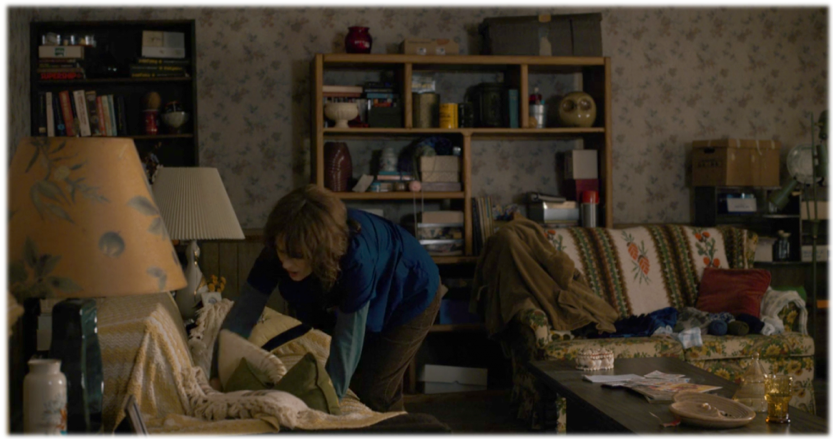
Stranger
Things is heavily inspired by the 80s era, with all the costume, set and props
perfectly made to look as if it were 35 years ago. It also takes huge
inspiration from the films of that era and it is almost unbelievable how many
elements of Stranger Things have been copied from older pieces.
Stranger Things is crammed full of almost identical camera shots from films such as E.T The Extra-Terrestrial (1982) and The Goonies (1985). The effect is that they help drive forward the narrative of Stranger Things but also help the audience understand the characters. The way the Duffer Brothers have composed Stranger Things makes a show that is made up of old material feel new.
Stranger Things is what’s known as a pastiche: “an artistic work in a style that imitates that of another work, artist, or period.” It is similar to parody except instead of making fun of the influence, it pays homage to it. Stranger Things is a pastiche of many films from the 80s and uses them to construct its own narrative. However, the problem with this is that films that use heavy intertextuality can overuse it which ultimately can ruin the film. From TheNerdWriter’s video: Intertextuality: Hollywood’s new currency, he said “A lot of Hollywood sequels, remakes and reboots use references to their own history as a frequent but unsatisfying replacement for actual drama” (Nerdwriter1, 2016)
This is what is so remarkable about Stranger Things, it uses very frequent intertextual references to other films, but yet still manages to not fall into the trap of using it as a replacement for actual drama.
Stranger Things can be argued to be almost a straight rip off of some films from the 80s. It appears that the producers of Stranger Things took great liking to the works of Steven Spielberg and Stephen King. So much so that they ripped entire shots and sequences straight out of those films and used them in their own. In fact YouTube user Ulysse Thevenon made a nearly 5 minute video of all the shots that are direct copies from other 80s films.
As you can see there are shots that are blatant copies of other, but there is a purpose of using these shots from these films in particular.
They all help with the character development. Take the film E.T for example, it’s all about an alien that comes to an unfamiliar world and is taken care of by a young boy and his friends. Then compare that with Stranger Things, the narratives are very similar. The character of ‘Eleven’ is the substitute for E.T and ‘Mike’, ‘Dustin’, ‘Lucas’ etc all take care of her. They are using the similar shots as a way to help the audience understand the characters better and are using it as a form of intertextuality to invoke an emotional response from the audience.
Using the other films as an intertextual reference helps the audience to make sense of what is happening on screen and also to help predict the path her character will take. Similarly, where the film E.T is all very innocent and has no real dark euphemisms there are other films that the producers used to help show the character. The nice references to E.T are contrasted with darker references to films such as Firestarter (1984) and Poltergeist (1982). These darker and more malicious help to juxta-pose the good ones and help guide the audience again as to what path the character will take. For example, ‘Eleven’ has been abused since she was very young in the Hawkins Labs and through flashbacks of these events and the similar shots from the other films,
the audience can relate her character to the ones from the other films. This clever form of intertextuality manages to portray characters without falling into the trap of having it replace actual drama.
A very similar thing also happens with the character of ‘Joyce’: the mother of the boy who has gone missing. The producers used shots from the film Close Encounters of the Third Kind by Steven Spielberg to compare her character to the one of ‘Richard Dreyuss’ in Close Encounters of the Third Kind. Both characters are seen going crazy but for good reason. However, they also use an intertextual reference of the character ‘Jack Nicholson’ from the horror film ‘The Shining’ who has gone genuinely crazy. Once again, this comparison of characters and use of intertextuality helps the audience make their mind up on the character they are watching and how their personal narrative will play out.
Straying from intertextuality, the other key concept I am going to apply to Stranger Things is the concept of fandom and all that encompasses it. Fandom is the term used to describe a group of people who all share a similar interest in something.
Thanks to the development of the internet, fandom is now a huge part of the ecosystem of a product. Fandom gives the fans a chance to express their thoughts and opinions on what it is they enjoy, and they can express them to other members of that fandom.
Henry Jenkin’s fandom theory analyses how the way we respond to a text shapes our real-life identity and how whether we are an active or passive audience can also in some cases effect how the product is actually produced.
Jenkins came up with 5 levels of being a fan.
- People who simply consume the product and strike a balance between having an emotional response and being critical of the product but not acting upon it.
- People who create parallels between the narrative of the product and the narratives of their own lives
- People are part of the active audience and reach out to producers to give them either advice or praise etc
- People creating their own fandoms, where they create and consume their own user generated content as well as discussing and consuming the original work
- People create their own alternate reality where they attempt to create their own alternate reality surrounding the product.
Jenkins also said “Fans do not simply consume pre produced stories; they manufacture their own fanzine stories and novels, art prints, songs, videos, performances, etc.” (Jenkins) This sub-culture is something that producers strive for as it allows them to have a super dedicated and active audience base as well as it shows that the audience care enough about what is being produced to try and make sure that it is produced to the highest standard. Having a strong core audience is one the most important steps to becoming a successful production.
Fandom has also had a monumental boost of popularity thanks to the uprising of web 2.0 and the internet. If It were not for the internet, many fandoms that exist today may not have ever come to be. While there are physical places that the fans could go to discuss their favourite products such as meetings or conventions such as the now world-renowned San Diego Comic Con; the role of the internet in fandom is undeniably crucial. It allows fans to congregate and find communities much easier and without the risk of being mocked by others that don’t share the same interest. The internet is like a safe haven for fandoms to thrive and that is exactly what they have been doing.
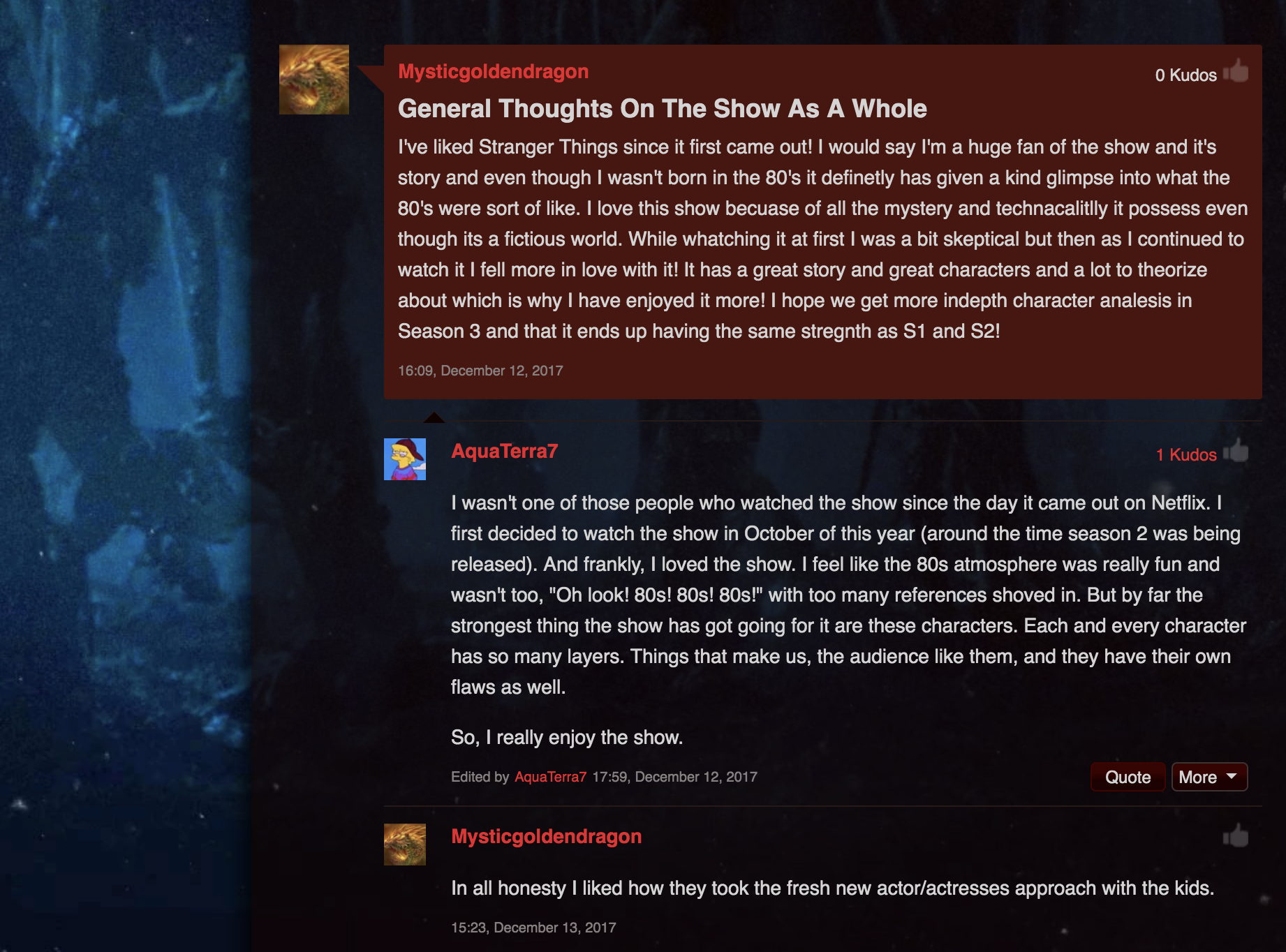
In terms of Stranger Things, their fandom is similar to that of any film or TV show where the fans will go to certain platforms and then discuss everything about the show. Typically, fandom sites are blog or discussion sites that are text based and have multiple threads of information that users can interact on. For example, the site Reddit, which is the largest discussion website on the internet, hosting 542 million monthly users. The most popular Reddit forum for Stranger Things is r/StrangerThings which has over 342 thousand users. The way it works is that someone will start a thread on a certain topic and then other people can come and go as they please and comment and talk to each other about said topic.
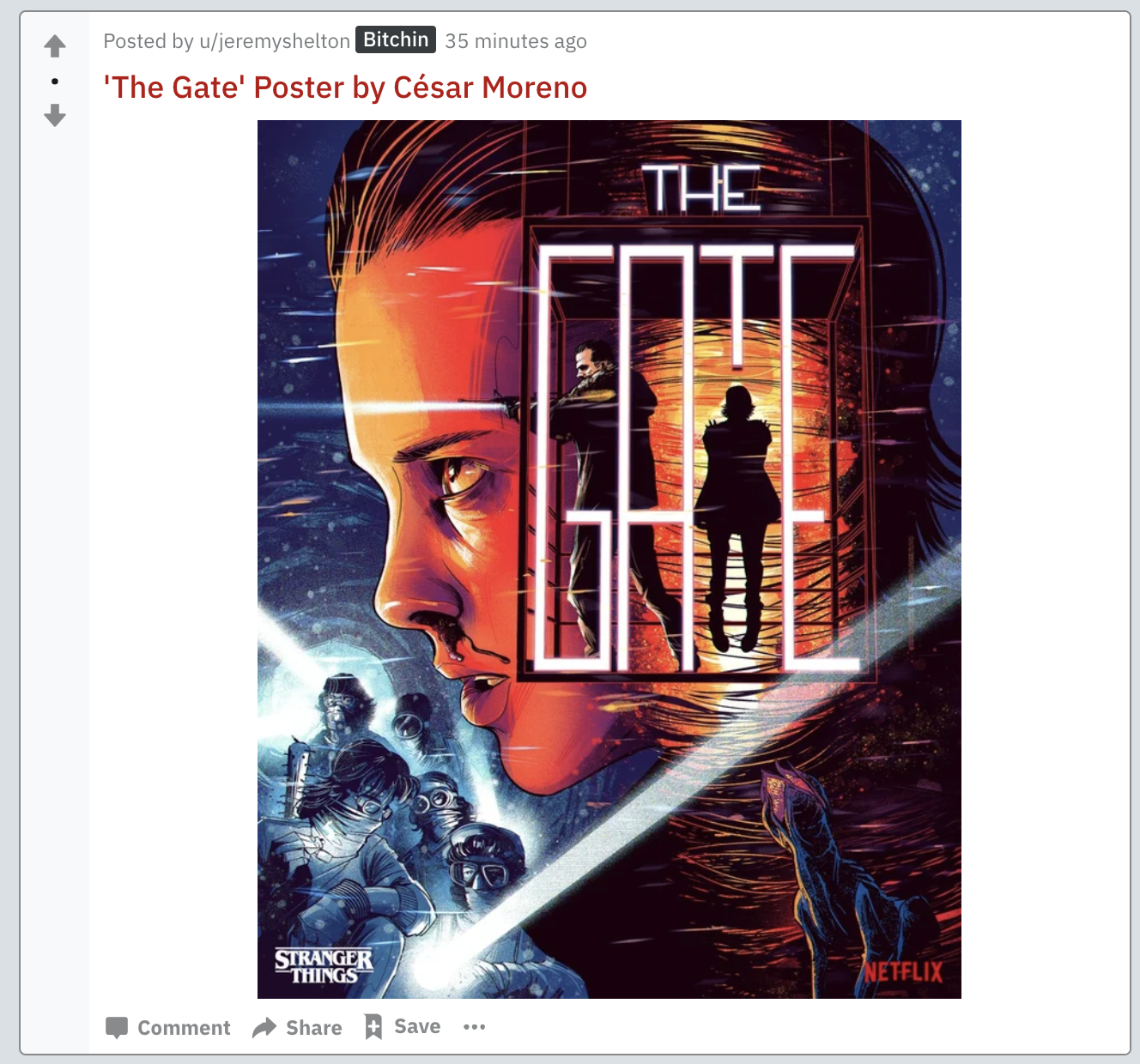
There are a multitude of different ways that fans can show their love and interest for the show. Most commonly people will post fan art that they have made that depicts the characters from the show. Some people even write their own fan-fictions where they take the characters from the show and then write their own stories using them for other people to read and enjoy. Thus, fandom gives a whole new branch of meaning to “active audience” to the point where the audience becomes the producer and makes their own user generated content for others to enjoy.
However, while fandom has done lots of good for the media industry it also has its bad points. Toxic fandom is one of these bad points, where the fans take what they like but take it to an extreme that can be negative and, in some cases, destructive.
“Possessiveness, entitlement, and a feeling of superiority are the three main ingredients in the toxic fandom stew.” (Lefler, 2018)
One popular example of a toxic fandom is some of the fan base of popular animated TV show ‘Rick and Morty’ essentially a parody of ‘Back to the Future’, Rick and Morty has bred some of the most toxic fans on the planet. Some fans believe that the show has such high-level humour that normal people couldn’t possibly appreciate it. It is a well-known fact online that the Rick and Morty fan base is comically possessive of their sacred show. Almost as if they think that they own it, much like an animal protecting its territory. So much so that even the creator of the show Justin Roiland has expressed his dis-taste to some of the people that are fans of his work. While toxic fandom makes up only a small percentage of all fandoms, it is still an un-escapable element of fandom that audiences and producers alike will have to simply deal with.
I as a consumer have seen both series of Stranger Things, at first I was sceptical about how entertaining it would be since I am not much of a fan of sci-fi or horror. I had heard countless times from others that it was really good and that I should watch it and so I did. Personally, I really enjoyed it, I found the characters very engaging and easy to relate to and I actually cared about them. The story while it did seem familiar, I never picked up on how similar it was to other films I had seen such as E.T and Close Encounters or any of the other films that Stranger Things takes inspiration from. I thought that in both series the cinematography was amazing, and the narrative kept me wanting more and that was all I could’ve asked for from the show. From analysing Stranger Things, I have come to realise how creating an original product really is. And how using Harold Bloom’s theory authors find new ways of presenting essentially the same thing to us but make it slightly different so that we enjoy it while maintaining the same archetypes.
Going back to TheNerdWriter’s quote: “A lot of Hollywood sequels, remakes and reboots use references to their own history as a frequent but unsatisfying replacement for actual drama” I would say that Stranger Things, while using a huge amount of intertextuality doesn’t use it as a replacement for actual drama. I think instead it uses it to help the development of characters and the plot for the audience to enjoy for themselves. As for fandom, I had never known that the role of fandom in the mass media was as important as it is. I knew that fandom had existed but always seen it as something that was reserved for the more “Geeky” or “Nerdy” fans. Having done the research surrounding it I now have much more respect for the fandoms and the role they play in shaping the way my favourite products are produced.
Throughout this essay I have analysed how intertextuality has shaped and affected Stranger Things, as well as looked at how fandom supports Stranger Things and other products alike. My main point was that intertextuality plays a huge role in the way products are produced and received. From the research I have done I can conclude that intertextuality helps the audience to understand the narrative and the characters better as well as helping to induce an emotional response and can be used to trigger nostalgia to help entertain the audience. I also conclude that fandom is a necessary part of any successful product and that despite having some bad parts, it still plays an essential role in the shaping of products as well as their fanbases.
Reference List
Basement, M. (2016). Stranger Things is a Better 80s Movie Than Most 80s Movies. [online] YouTube. Available at: https://www.youtube.com/watch?v=MgAVbTR5cOw [Accessed 18 May 2019].
Bloom, H. (1997). The anxiety of influence. New York: Oxford University Press.
Ellis, L. (2017). Stranger Things, IT and the Upside Down of Nostalgia. [online] YouTube. Available at: https://www.youtube.com/watch?v=Radg-Kn0jLs [Accessed 18 May 2019].
Georgialaymedia.blogspot.com. (2019). Henry Jenkin’s fandom theory. [online] Available at: http://georgialaymedia.blogspot.com/2019/01/henry-jenkins-fandom-theory.html [Accessed 18 May 2019].
Haenfler.sites.grinnell.edu. (n.d.). Fandom and Participatory Culture – Subcultures and Sociology. [online] Available at:
Fandom and Participatory Culture[Accessed 18 May 2019].
Lefler, R. (2018). What’s Toxic Fandom, and What Creates It?. [online] ReelRundown. Available at: https://reelrundown.com/misc/5-Factors-that-Can-Cause-Toxic-Fandom-to-Arise [Accessed 18 May 2019].
Media Studies 101. (2013). Fandom. [online] Available at: https://mediatexthack.wordpress.com/2013/12/01/fandom/ [Accessed 18 May 2019].
Metzger, P. (2017). The Nostalgia Pendulum: A Rolling 30-Year Cycle of Pop Culture Trends. [online] The Patterning. Available at:
The Nostalgia Pendulum: A Rolling 30-Year Cycle of Pop Culture Trends[Accessed 12 May 2019].
Oller, J. (2017). What’s Old Is New Again: ‘Stranger Things’ and Intertextuality. [online] Film School Rejects. Available at: https://filmschoolrejects.com/whats-old-new-stranger-things-intertextuality/ [Accessed 18 May 2019].
Olson, N. (2017). Nostalgia for Stranger Things – Image Journal. [online] Image Journal. Available at: https://imagejournal.org/2017/11/07/nostalgia-stranger-things/ [Accessed 18 May 2019].
reddit. (2019). Netflix’s Stranger Things • r/StrangerThings. [online] Available at: https://www.reddit.com/r/StrangerThings/ [Accessed 18 May 2019].
Wolfe, A. (2017). Harold Bloom’s Critical Thinking.
[online]
WSJ. Available at: https://www.wsj.com/articles/harold-blooms-critical-thinking-1491582477 [Accessed 18 May 2019].
YouTube. (2016). Intertextuality: Hollywood’s New Currency.
[online]
Available at: https://www.youtube.com/watch?v=QeAKX_0wZWY [Accessed 18 May 2019].
YouTube. (2018). The Rise Of Toxic Fandom: A Theory.
[online]
Available at: https://www.youtube.com/watch?v=HCKF2_-Zsw0 [Accessed 18 May 2019].
YouTube. (2019). How Does Fandom Work?. [online] Available at: https://www.youtube.com/watch?v=EmuuOJms62s [Accessed 18 May 2019].
Kannik, H. (2014). Storytelling Intertextuality. Film International, [online] 12(1), pp.85-97. Available at: https://eds-b-ebscohost-com.libezproxy.bournemouth.ac.uk/eds/detail/detail?vid=6&sid=05729de8-d34f-4d1b-8154-e2c88e6d14ca%40sessionmgr101&bdata=JnNpdGU9ZWRzLWxpdmUmc2NvcGU9c2l0ZQ%3d%3d#AN=99367939&db=vth [Accessed 18 May 2019].
Olney, I. (2010). Texts, Technologies, and Intertextualities: Film Adaptation in a Postmodern World. Literature/Film Quarterly, [online] 38(3), pp.166-170. Available at: https://www-jstor-org.libezproxy.bournemouth.ac.uk/stable/43797653 [Accessed 18 May 2019].
Staff, W. (2018). The 10 Most Difficult-to-Defend Online Fandoms.
[online]
WIRED. Available at: https://www.wired.com/story/10-most-toxic-fandoms/ [Accessed 18 May 2019].
 Understanding media - Case Study Analysis/Reflection